• About
  • Bringing Art into the Fold
  • Take A Walk With Me
  • Threads
  • The Beginning

Peter's Blog

  • Bringing Art into the Fold

    Oct 26th, 2023

    So, we’ve been exploring the idea; we’ve been trying to get inspiration, and I think at this point there is enough for other people in the team to get their teeth into. But this brings up one of the big designer problems you have. How do you get a picture that’s formed in your mind into other people’s minds? 

    And make sure it’s the same picture?

    Because very often in the past when I’ve tried to do this, I’ve made the mistake of saying ridiculous things like, “Oh yeah, it’s kind of like a medieval scene and it’s foggy streets and it’s, you know, it’s autumn,” and let them create something out of that simple sentence.

    But after you make that mistake, you realise what they need is enough information so that what they create, what they sketch and what they draw, and what they code even, is going to be the same as the picture in your mind. Otherwise, you end up with a cacophony of imagery. Which can be useful by the way – you can find the diamond in rough – but more often if you don’t explain your idea clearly enough, if you don’t try and get people into the right mindset, you’ll end up with just the colour brown.

    You end up with loads and loads of different sketches, but none of them really fit what you want.

    You’re not doing the right job as a designer. So inspiring people in the right way so they create the right image is both incredibly expensive, because it takes people days, if not weeks, to create the scene that you want them to create, and it’s incredibly demoralising, because someone spends – and that’s really what makes a great artist, by the way, in my view, the passion that they put into their project – if you are trying to get a concept artist or a general artist to do something, and you look at it and they put their heart and soul into it, and you then turn around and say, “Yeah, but not like that,” It’s just awful for them.

    So what there has to be is, there has to be a real conversation about what you want them to create. It’s not as simple as saying, you know, I’ll just create something beautiful. It’s a deep and meaningful conversation. And very often the conversation is more about feel than look, because if you inspire them in a certain way where you say, “I want roofs that are pointy, they should be brown, made of brown slate,” then they go and do just that. But they’re the experts in this. They’re the ones that should decide the little details. You don’t want to paint the picture for them. You want to get the best out of them. So it’s about look and it’s about feel. But it is less about look and more about feel. And it’s also about quality.

    When I talk to the press, I’m really talking to them in the same sort of way that I talk to the people that I work with. You know, it’s an inspiring way. And I think it’s completely right to say, “Look, we want this to look great. It’s got to be great. Just by just looking at a single screenshot from any point of view, people have got to go, that looks amazing.”

    It’s got to feel unique and it’s going to feel different, but it’s going to feel familiar. Those sort of very bold, let’s make something great, statements. I think you have to use those when you’re trying to explain an idea. You have to make the person creating this uncomfortable because you’re pushing them. You’re pushing them against the edges of their skill.

    What you don’t want to do, and what they absolutely do want you to do is, you don’t ever want to say, “Make it like that, but better.”

    That defines their vision, and people will take something that looks like one thing and they’ll make it slightly better. So you referring to other games is the route to sameness – to a sameness about graphics and gameplay and everything else that makes up a game.

    And that’s not what I personally like to strive for. I like to strive for uniqueness and originality and pushing the envelope of what I and the team, and hopefully the people that play the games, think of as gaming. So that’s why I’ve loved and adored creating everything from Populous to Magic Carpet, to Dungeon Keeper, to Black & White, and even to Fable – that element of uniqueness.

    If it’s time to inspire people to create concept art, to do prototypes, then this blog really should talk about how you prepare for something like that.

    You can do things like mood boards. I’m quite a fan of mood boards. Even if it’s me doing mood boards. If I do a mood board, I don’t do an actual physical one. That would be ridiculous. I use Keynote. It’s free on the Mac, and it’s just beautifully put together. It’s not fiddly. It’s just a joy to use. If I’m trying to inspire concept, I’ll grab images from the internet. And it is so much easier now that we have this.
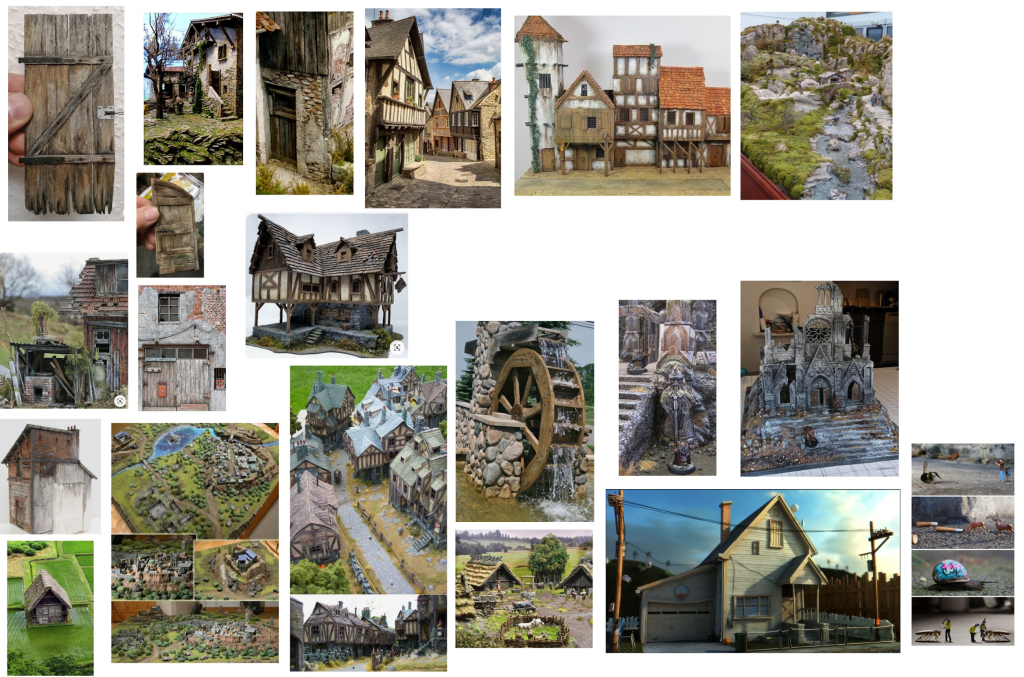
    One of my mood boards

    In the earlier days, we didn’t have things like Keynote or the internet even. We had to use reference books or, or photographs we’d taken. So I’ll use those boards, but I won’t put a huge amount of text in those boards. And I prepare what I’m going to say, because what I’m doing is preparing for a conversation.

    I’m going to call it a conversation rather than calling it a meeting, because a meeting implies that you are telling people exactly what to do, what pixel to draw, and what piece of code to write. So this conversation has to happen in a kind of living way. So I’m preparing all the materials for that, but most crucially, I’m preparing the narrative of what I’m going to say, and I can’t stress that more strongly.

    Getting the narrative absolutely right to play out in your head, I’ll really prepare it and take it seriously. So when I’m sitting down with someone and I’m trying to explain what’s in my mind, I’m prepared for that. I know what points I’m going to hit.

    I know and honestly feel the bits of what I’m going to say that are most exciting, that I almost get emotional about because I’m so excited to have that conversation. So while I’m preparing that message, I’m preparing the kind of virtual mood board. And I’ll quite often, before having that really crucial conversation, I’ll try and find some people who are patient enough that I can explain the idea to and have a little practice conversation, because you can’t practice with the person you are inspiring. So ultimately, when I’m ready, when I’ve got the narrative, and I’ve got all the materials, the next thing I need to do is find the great people to inspire, to create those prototypes.

    And I’m so lucky, and this is an incredible advantage, in having worked with such brilliant people, That means that I can ask people I’ve worked with in the past if they could help out and do some work. And there’s one person that I’ve worked with in the past that really stuck in my mind, and his name’s Kareem Ettouney, and he is so sublimely talented. He’s just an amazing, incredible person. I chose him because he’s got an incredible mind.

    He’s like a force of nature.

    Sitting down with Kareem and talking through the idea and the feel, the look of the game and the feel of the game, the feel that you want a player to have that moment they see one shot of the game – that conversation has led to a number of sketches.

    Kareem’s early sketches

    And these sketches are really, really quickly done. They’re not incredibly detailed drawings. They’re not supposed to be a proof of what the graphics intend to do. They’re really just the beginning of this conversation about what the game should look like.

    In the past, this conversation was easy because I had this amazing person, Paul McLaughlin, every game that I’d worked on from Syndicate on that syndicate in 1990, 1989, right up until Legacy, he was the Art Director.

    And Paul, we had worked together so long that I could sit down with Paul, show him the mood board, have a conversation, and he would say, okay, and he’d go off and come back with an almost identical and quite often improved image of what was in my mind. But sadly, and it was a great personal sadness, Paul passed away in 2021.

    Trying to find a great Art Director who actually would be willing to work with someone like myself has been really challenging. I didn’t want to put the idea on the shelf until we did find that great art director, so I was in the incredibly lucky position to reach out, to be able to reach out to Kareem, who is undoubtedly one of the greatest of great people I’ve worked with.

    And Kareem has got this wonderful way of taking an idea and exploring it and enhancing it. So Kareem and I had this fantastic conversation. I referred to my mood board. I managed to hit all the gameplay points. And you can always tell when something works when the person that you are having this conversation with is actually feeding back and saying, well, does that mean this? Does that mean that? And Kareem did that in absolute spades. I was as equally inspired as he was.

    So because this blog is a piece of serial information, as in you read it sequentially, I need to explore what actually happens in a serial way. But I’m not going to do that entirely because there are some things I’m not going reveal at this point, simply because I want to justify some of those points beforehand.

    But I will share with you some of the mood boards that I put together. And I’m also going to share some of the sketches that came out of our conversation. And I think what that’s going to do is, it’s going to give you some hints about what this game is. What I would say to you as you’re reading, don’t presume the obvious, because what we are doing is exploring something fresh and new and different, in this familiar environment anyway, because this week is the week that we are releasing Legacy, which is another unique gameplay solution to a problem. So I’m gonna keep this blog short and get back to the launch.
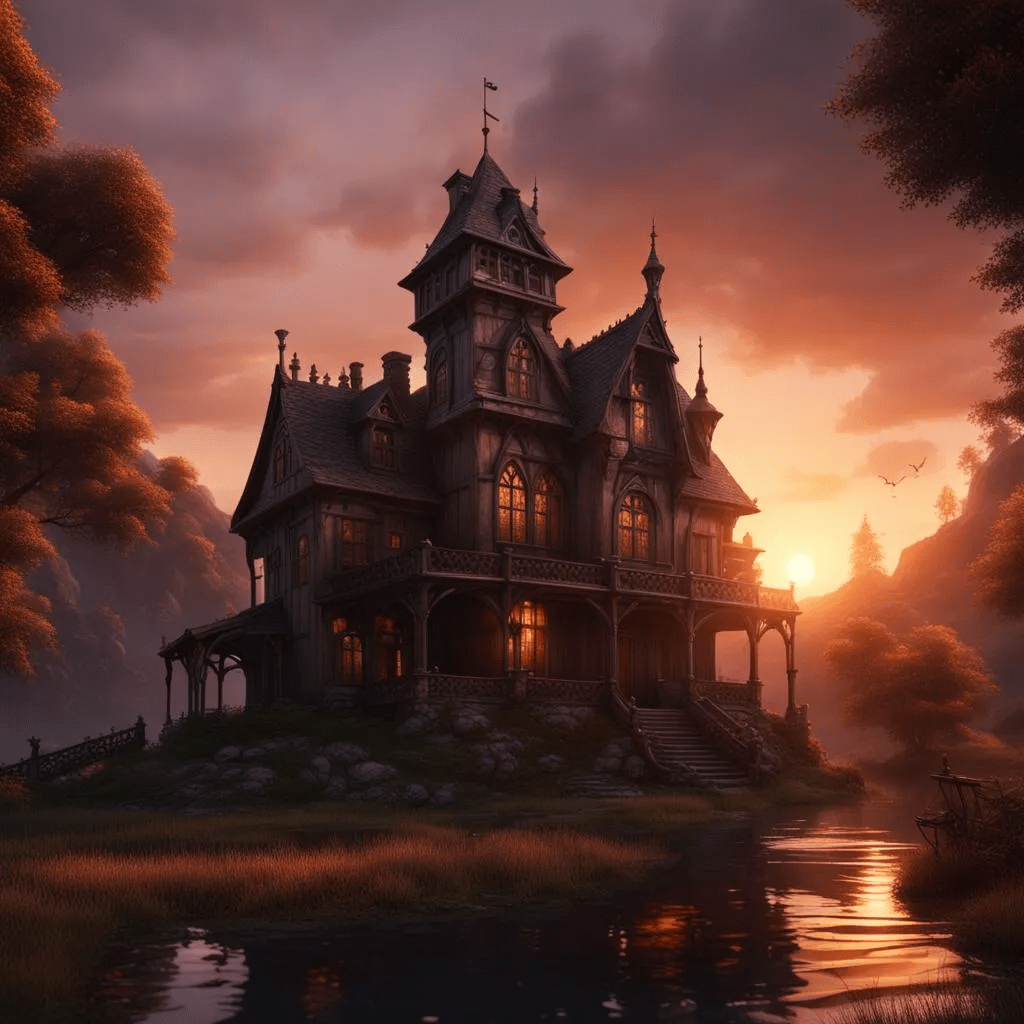
    This is what happens when you get involved with using AI image generators – wonderful tools for early concepting

    But before I go, a little bit of fun. I’m adding a link here at the bottom to give you a chance to be in the designer’s seat for a litle. Have a look at this survey, and see what you’d chose if you were presented with these images at the early concepting stage. I’d be very interested to see if you think along the same lines as I do. Some of these images were presented to me, some I’ve grabbed myself as examples of what I would have presented.
    Design Feedback

  • Take A Walk With Me

    Oct 19th, 2023

    A shocking thing happened to me last year when I bumped into Mark Fletcher, one of the artists who worked on Fable One, and he said, next year is the 20th anniversary of the release of Fable.

    Firstly, it came as an enormous shock that 20 years ago, Fable One came out. 

    Secondly, it pulled back a lot of memories I had and feelings I had about the entire Fable series. 

    And lastly, and most importantly, it sent me into this reminiscing state about the world of Albion and just how much I loved that world. I should say that the world of Albion was created by a group of us. Dean Carter was a genius who worked on the mythology and the feel of the world, and Paul McLaughlin helped with the art style – the list of names goes on, and on – but that reminiscing caused me to explore this idea:

    Could we set a game in the world of Albion and make that game something fresh and new and different?

    I know that Fable 4 is coming out and that further prodded me into obsessing about setting a game in the world of Albion, and the more I thought about it, the more I realised what a fantastic world it is. Firstly, I think of Albion as Old Britain.

    And secondly, I think it still remains as one of the most funny worlds where all the people and all the events had a tinge of dark humour to them. 

    And thirdly, and this is most important because Fable itself didn’t really have jokes as such, what made it funny for me, and I think made it funny for a lot of people, is just the ridiculous things that you could do and the ridiculous choices that you had, and the consequences of those choices. 

    So this reminiscing really meant that I started to think if I was going to set something in the world of Albion, but maybe not specifically about heroes, what would that be? What fascinates me about Albion? And that kicked off these trains of thought in my mind and allowed me to really start exploring the idea in my mind of a familiar Albion, a familiar place with a lot of humour.

    I had a free weekend in which my son Lucas and I went round some of the local environments that inspire me and remind me about what Albion’s all about. These are all places in and around Guildford, places I’ve visited many times before, and I think these will give you a good idea of where my head has been at recently, and what has been influencing my thoughts around a new game. Fortunately, we had access to a drone (Lucas is doing a degree in film in Bristol right now), so some of this footage is drone footage and some of it is captured just on a plain old digital camera. 

    This is Saint Catherine’s Chapel, an old ruin. We had a few team shots in there in the early, early days of Bullfrog, but this location’s always stuck with me. And the reason it stuck with me is the contrast you can see between the old and the new.

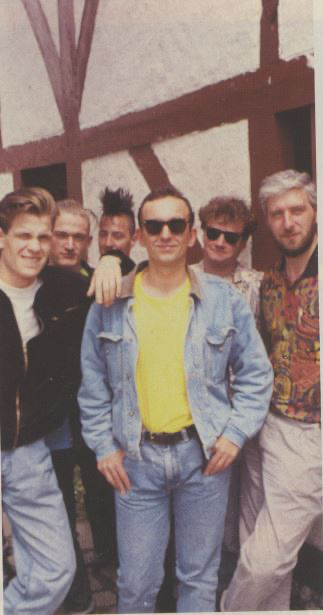
    Still got the jacket. Don’t still got the hair. Team Bullfrog, but not outside the chapel, can’t find that one.

    The view from St. Catherine’s, when it was built 800 years ago, must have been this serene, beautiful, pristine landscape. In fact, in the video, is a 300 year old painting of the chapel, and you can see it was a ruin back then. But it’s that contrast between ancient and modern that highlights the way human beings have spread out over the countryside and consumed the old beauty. That’s the first thing that really resonated with me. And after thinking about this, I really started to obsess about nature.

    And man.

    Mankind has spread out and kind of almost corrupted the nature around him. And I think as a mechanic, that is something that has stuck with me. This idea that whatever we do, we’re gonna fuck it up somehow.

    The second thing is this view.

    The height of St. Catherine’s Hill and its closeness to Guildford, just down below the hill, makes it look like we’re almost at an isometric angle. And I’ve always loved that isometric angle. The first real game that I did, Populous, was in a perfect isometric angle. Syndicate was also isometric. And we made this huge mistake in Theme Park by only having isometric in one direction. The great thing about the isometric angle is that this projection doesn’t portray any perspective distortion, meaning you can see anything in the foreground and background clearly at the same time. Don’t get me wrong, let me say now, this is not going to be an isometric game, but it’s still an inspiration.

    Anyway, there’s two things that I get from this location. The view and how exciting it is to see this little world with all the people living and working below you, and the coexistence of the old world and the new world. The thought I had was that the new world is created out of man’s necessity. The world has been shaped because of man’s need to thrive and survive.

    So maybe you can see where I’m going with that. Let me just remind you that this blog is exploring. You’re not going to get specific ideas for a little while, so just stay with me.

    Just down the road from St. Catherine’s Chapel is Watts Chapel. It’s the most incredible place. Aldous Huxley, incidentally, is buried in the graveyard. Watts Chapel was built by a group of people from the local village in honour of George Watts, who was this famous Victorian sculptor.

    If you look at these pictures, there is a mysticism about this place And I love it. I still have an incredibly fervent passion for the idea that magic exists today. Looking at these pictures, you could imagine that this was a centre point, a focal point of magic. I love exploring magic. I have some real foundational beliefs about what a magic system should be, and that is that magic has to have a cost. I thought one of the most brilliant examples of that was in a book written by Neil Gaiman called Stardust, where every time they used magic, they just aged terribly.

    Remembering back to Fable, we had these amazing swords, weapons you could upgrade, and fantastic armour, but what has always lingered in my mind is the question, who made this stuff? Who made the Sword of Aeons and what’s actually in it? Is it the metal from a meteorite from Alpha Centauri or is it a couple of old tin cans that have been melted down?

    I’ve become more and more obsessed about this, about who makes this stuff and how do they make it? And why did they make it? And that got me thinking about things like what did people eat in Britain in the years 700 to 800? Who made all the food? Especially for the armies. Who is producing food for these huge groups of mobile infantry? How do you feed thousands of men who are marching across the country heading to what could be their doom? How does it all work?

    And this brings me to the other thing I find absolutely fascinating, and that’s the brutality of life in the past. Anywhere from Victorian times and back, just the pure brutality of life. In this world there was no health service, no social systems at all. No law, no police force, no social care, no pensions, no unemployment benefit. 

    And then you mix into that world progress, and this is what we were beginning to explore in Fable 3 except we didn’t really have the time to get deep into it, the industrial revolution happening in a world where magic existed.

    If you think of that industrial revolution, we look back and think of it as a wonderful time. Mankind were brilliant. We were lovely. We were weaving materials and we were cutting grain, and we were manufacturing things where before the industrial revolution, everything that was made, everything that was consumed was done in the home.

    If you wanted milk, you had to have a fucking cow. If you wanted a table, you had to go and chop down a tree. And then up came this industrial revolution and said, fuck all that, that’s silly. Why don’t we just start manufacturing specific things, rather than everyone making one single thing at a time?

    And so these factories were created, and Guildford is a great example of that time. Guildford was a town that was based on the wool trade. And that’s why the whole town is centred around the river. 

    These manufacturing places were places of utter brutality. We’re not talking about the occasional accident. Literally, they were built in such a way that children as young as six were the only ones that were small enough to get under the machines to clean them. There were saw blades running over their heads, slicing away while they scrambled beneath the machines, in dire jeopardy. One false move and you lose a limb or worse. We can’t even imagine a world like that now. And furthermore, if one of these kids got their hand sliced off or their legs sliced off then the only thing that happened is they couldn’t go to work the next day. There was no health service to look after them. The 7-year-old’s stump was no concern of the owners. There was no employment law. The owners didn’t care. A kid got his arm chopped off. We’re gonna find another kid to replace him. And that’s the only thing that they really cared about. And I think for a game, that’s a wonderful theme to explore. 

    On the one side you’ve got progress. When you think of the word progress, it’s probably a golden word in your mind, an example of why human brings are fan-fucking-tastic, because of progress, because of invention. And on the other side of the coin are the consequences of that progress. That in the Industrial Revolution you are going to have to reorganise society just to cater for this progress. Which ultimately gave birth to the modern world that we live in now, where we do care about each other and we care about social justice and social care. But that’s an interesting thing to explore, progress versus compassion.

    There are great examples of that found around Guildford as the Industrial Revolution went on. Incidentally, in this blog, anything you read, I’m not checking. This is just what I believe. And you are probably going come back and say, oh no, the Victorian Times had a police force for whatever, but this is just what I believe. Historical facts can of course be of great use when game designing, but never let it be said that fantasy and imagination are not the most powerful tool in a creatives bag.

    I think the people that were pushing for progress, for invention, and ultimately for profit, probably thought they were doing a fantastic job. It must have been an incredible feeling that suddenly you were creating things that had never been created before. And that must have felt amazing. It’s not like starting a business now. They were making things for the very first time.

    Take food. Before factories, how was food made on a large scale? If, for example,  you wanted thousands of people to do something, you have to worry about the food. About feeding them. And how was that food even manufactured? How do you feed an army of thousands marching across the country?

    So you’ve got Mr Progress, who’s inventing things and making factories and running factories. And then you’ve got the people who are actually working in these factories. To them it was probably a nightmarish hell, but history only briefly touches on that. They had to leave their homes, they had to leave their families. They had to go and work in these incredibly dangerous places. There was laughably no employment laws at all. An employer could come to them and say, you’ve gotta work for 16 hours a day for seven days a week.

    And I believe I’m right in saying that the average working week was 110 hours. 16 hours a day, seven days a week. I do wonder why, why those people who lived in the countryside on small farms,  and I wonder why they left to go and work in these factories and towns. 

    I’m quite excited to talk about brutality versus kindness, because I think that the business owners, the entrepreneurs that start off these factories, didn’t give a shit about the workers. But they got a bit rich and then they got a bit guilty. So they started building these places that people could survive in. A great example of that, is the work house.

    Work houses were seen as a brilliant thing at a time when there was no social care at all. If someone was completely out of work and they had no food, they either became a criminal and stole things to survive and eat, or they died. So they built these workhouses, and the idea was you went to a workhouse and you could get a free meal and you got a free bed. And if you look at these pictures, it was a ghastly, it was just like going to jail basically. But at the time it must have felt absolutely wonderful. But now we look back at workhouses and think, oh, what a terrible thing. 

    This is Waverley Abbey, and it’s really interesting to me because if you look at the estate it’s in, it’s right next door to this enormous stately home. The contrast of the abbey to the stately home, that it is in ruins and a symbol of the old times, next to this at-the-time modern, decadent, expensive private home, and the sort of the coexistence of man and nature, where the old building sits with much of its grounds taken back by Mother Nature, is really fascinating. 

    Now the other things that are near here are the Gunpowder Mills. And if you look at this picture, there was this gunpowder factory just down the road from where we are now, where they made gunpowder.

    Have you ever wondered how they make gunpowder? In this factory they literally ground up sulphur, saltpetre and charcoal, and mixed them together in these huge vats. Well, of course this whole building just exploded. It was completely fatal, but it was in this beautiful, amazingly green and lush landscape when we went there, and there’s this real feeling of foreboding. Here’s a building that was built with complete disregard for any safety and complete disregard for where it was built. I mean, it totally polluted the entire area, including the rivers, because of their manufacturing processes and scant disregard for the area.

    Look at the way this factory is constructed. It’s built for purpose and nothing else. When they built this place, we hadn’t invented safety. We had to invent safety. Machines were being invented for the very first time. This was the first time that steam was used and water was used to power things. When Leonardo da Vinci or whoever was drawing plans for machines, he wasn’t thinking, “What are we gonna do about the safety of this?”

    No, they were so busy thinking about whether this thing they’re inventing would actually work, there was no interest in whether it was safe. And then it does work, and then things progress and then it took a remarkably long time for anyone to come up and say, let’s just put a guard on that. Let’s just make it so that people don’t die.

    Sometimes when you’re thinking through an idea, these weird coincidences happen. And the weird coincidence that happened around this is that, well, I love listening to audiobooks, and I’ll listen to an audiobook if I’m walking the dog or if I’m driving somewhere, wherever I can really. Anyway, I had just started listening to an audio book called A Little Hatred by Joe Abercrombie. The world that Joe Abercrombie had created felt so much like Fable, especially in this series of books. 

    It was the humour that really won me over to the books and reminded me of Fable. So Joe’s books were a fantastic inspiration.

    Right, this article has explored Guildford a lot and how fascinating and inspiring that has been, so next time let’s go into a little bit more detail.

    Just to remind you that you’re going to have to be patient waiting for specifics and details because this is going to take a while. Sorry! Thanks for sticking with it – making games takes a long, long time.

  • Threads

    Oct 6th, 2023

    When I’m thinking of an idea for a game it starts usually in a totally inopportune moment with this idea: Wouldn’t it be great to get people who play a game to feel like they are experiencing some sort of emotion? 

    That was certainly true of the original Dungeon Keeper. I don’t focus on the mechanics, I don’t focus on the narrative, the story, or even the platform. I focus on what I want the player to feel. In Dungeon Keeper’s case it was, and Dungeon Keeper didn’t really explore this fully, but I wanted people to feel what it was like to be the bad guy, to be the evil dude who, if you’re watching a James Bond film, always gets fucked over by James Bond parachuting in and pressing one button and destroying your life’s work. And the games world had never really explored the intention or the background or the problems that megalomaniacs have, whether they be creeping around with a golden gun or hollowing out the centre of a volcano without anyone finding out about it. The sheer engineering feat of that far outweighs any evil intention, let alone the staffing problems. I mean just how do you get 10,000 people to help build a volcano. What do you put on the job advert?

    In Black & White’s case, it was what did it feel like to be responsible for teaching something? And in Fable’s case, what would it feel like to have the freedom to be any sort of hero, however good, or however evil?

    So it usually starts with that thought around a feeling that I want to give to a player. And then, after thinking about those feelings, the next thing is the setting. Is it going to be in space? Is it going to be under the ground? Is it going to be in some fantasy world? Is it going to be in some kind of totally made up world or the real one? So the setting comes next, and all of this is going on inside my head without really writing anything down.

    And I should make a note here that normally when I’m designing a game, and this is just me, it’s actually a terrible idea, so if anyone is reading this and thinking, right, this is how to design a game, don’t do this! I think, because of my dyslexia, I prefer not to write things down. I mean, you have to write things down when you’re communicating to a team, but in the early days, I think once I’ve written something down, I feel subconsciously that that’s it. It’s written in stone, there’s no more changing it. If you keep it inside your mind and keep mulling it over and thinking about it and wondering about it, and being very curious about how this idea evolves, then it’s much more likely to be fluid. And being fluid allows me to play around a lot with an idea. 

    There’s an example of this in the evolution of every game I’ve ever worked on, but if we take Black & White as an example, it was literally, “let’s do a game about a big creature that you teach using AI.” 

    That was kind of it. But playing around with that idea and thinking about it, thinking, if you’re going teach a creature, it needs to be powerful. If you’re going teach a creature, you need to be able to interact with it, and that gave the creature scale because you had to be able to see all those things, so Black & White started with a huge King Kong like creature which dominated the landscape. This feeling of you influencing something so powerful and huge could lead to interesting and novel choices. 

    So in the early days of a game’s birth, there’s a lot of exploration of an idea in my own mind. 

    Now the downside is you are depending on yourself to remember all that shit. Because it’s so easy to get excited about something, especially when under the influence of a mood enhancer. It’s very easy to forget about.

    But then I always think if you forget about it, it was probably shit anyway.

    I think of an idea for a game as like a thread. You start thinking about one element of an idea, and very quickly and quite nimbly, your brain goes, well, that means this can happen and that means this can happen. And those threads are all linked to some common route. I tend to let my mind just run freely over those different threads.

    What I’m really doing is creating the cornerstones of what an idea actually is. I think what I’m trying to get at here is that you’ll see these threads start to appear in this blog, and when I talk about an individual idea or element of an idea, you’ll see how that unfolds.

    The side effect, the downside of working like this is that you can forget about everything and you can get very lost in the idea itself. One of the upsides, which is what I find quite nice, is that you can walk into a room and say, I’ve got a new idea for a game, and people will say, what is it? And you’ll explain what that idea is, and then lots of people will ask you questions and you can just snap the answers off. You can say, you do this and you do that, and the player sees this and the player sees that, and the world will expand and it looks like you’re kind of making it up as you go along. Where in actual fact I’ve probably thought deeply about a lot of what I’m saying.

    Quite often though, when people do talk about it, when you do reveal it finally to a team of people, then the act of blurting it out causes my mind to make the connections, which perhaps I hadn’t consciously made before.

    If I was a proper designer, if I’d gone to university and studied game design, then surely I would write these ideas down and there would be this holy grail in design called a design bible, the design document. And very often when I have presented games to people like publishers and even the press, they’ll say this dreadful line: where is the game design document? Well, unless you ship me over with every game, there is no game design document. So, you know, if I was more sensible, I would absolutely spend the time writing a game design document.

    The problem with being dyslexic and old is that I don’t really have a choice. It’s not that I refuse to write a document, it’s just simply that I’ve tried to do it before and I get writer’s block. The trouble writing something down is that it’s linear. You start and you finish it. Sure enough, you can start in the middle and you can do other bits. But the way I find myself working is that sometimes I’ll be talking and then this idea will come up and I’ll tell the people I’m talking to to hang on while I think about that thought, and as I’m doing that the ideas are expanding, which just doesn’t happen when I try to write it down.

    Secondly, the act of typing or even talking is so fucking slow. It’s just way too slow. By the time I’ve typed this game is about, my brain has gone right, fuck all this, let’s think about what the credits are gonna look like or something ridiculous like that, so it’s not that I have a choice. I’m sure I could train myself to do it, but at 64, those days of training yourself to do something different I think are long gone.

    And I’ve lost my train of thought, so let’s stop here. Enough introspection, let’s start exploring this idea. In the upcoming blogs we will start to do just that.

  • The Beginning

    Oct 5th, 2023
    The last time I did anything promotional
    And here I am today…

    Hello reader,

    You probably know already, but I’ve been very silent in the press for almost the last 10 years. But now I’m considering a return to my roots and thinking about making a game for PC/Console.

    I really miss those days of being out, exploring publicly what a game is about. In the past that has led me into all sorts of trouble – as you develop a game, you try things out, and when you try things out, some things work and some things don’t. Now, in the old days, I used to talk about that process without really making it clear that some features may appear and then disappear. 

    Famously in Fable 1, I think I mentioned that if you planted an acorn, an oak tree would grow, but that feature was dropped from the original Fable, and I think that was the start of me getting in trouble. I’m deeply sorry if I offended or upset anybody by my often overenthusiastic and ill thought out press. The great thing about this blog is it’s not trying to do anything but explain the process (you’re probably going to see me get ridiculously exicted).

    But here we are in 2023 and I still would love publicly to share the thought process that goes behind creating a new game. And this thought process initially will be just the ideas that are bubbling around in my head, the things that I find fascinating, some of which I am sharing with the team of amazing people that I work with, and some of which are very much in my own head until they surface and become more sensible.

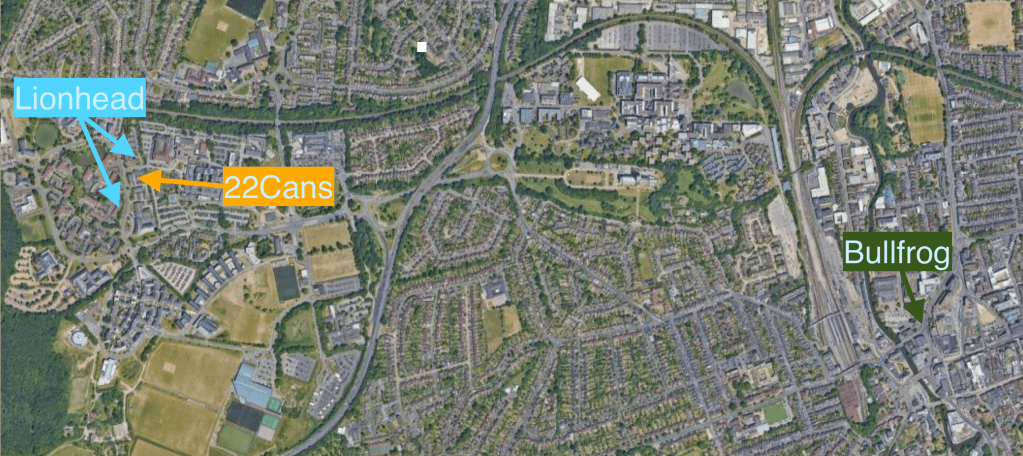
    Guildford’s always been the centre of operations

    So this blog is really going to start exploring one aspect that I’m very fascinated with and showing you some reference material, especially material from around Guilford, because both the original Bullfrog, Lionhead, and more recently 22Cans, are based around Guilford.

    A lot of what’s in Guilford has ended up inspiring both me and the people that I have worked with. For example, when we worked on Syndicate back in 91/92, all the buildings in that game had the same roofs as the offices that you could see through the window of the Bullfrog offices.

    Inspirational Syndication

    Also, a lot of the graphics, environments and other aspects of Fable were inspired by things in and around Guilford. So initially I think this blog will be exploring what inspires me, and when I say me, I really mean us at 22Cans.

    Okay, so as we explore these ideas and concepts, and as we move from pure idea to a prototype, and as the prototype moves from prototype to pre-production and onto production, and finally to release, there’s going to be many, many, many times when features bubble up, are explored, and then are killed. So if you are the kind of reader that gets excited about a feature, don’t get too disappointed if that feature is actually dropped.

    That’s the first thing. 

    The second thing is that I’m mindful to disable comments, and I’m going share something with you now – I’ve had a quite a lot of mental health issues as a result of all the turmoil that happened about 10 years ago from the Rock Paper Shotgun article, and it takes quite a lot of courage on my part to raise my head above the parapet.

    That’s the second thing. 

    The third thing is that I’m mindful of my age. I am 64 now. And although I’m as passionate as I’ve ever been about making games and creating games and working with incredible people and just seeing the incredible reaction that people often have to games, I am aware that at 64 I wonder how much energy and life I’ve got left to create games. So I’m not saying that this game is going to be my last game, but I am saying that time is running out and that is incredibly sad, but that makes this game, in my mind, very, very meaningful. I feel it should be something which represents parts of my career and the many games I’ve been lucky to work on.

    So I’m going to be stealing – I always think designers are great thieves of other ideas – but I’m going be stealing a lot of ideas from games that I’ve done in the past. And so you are going to see some references to those games because I think quite often you explore a mechanic or an interface or an idea, and you take it so far in a game, but you know, there are times when you think, ‘maybe we could expand that further’. 

    So, dear reader, please, please be patient. Please be understanding. Please don’t think that anything in here is a promise. It’s not a promise, it’s more of an exploration of ideas. And, hopefully, at the end of this blog, over many months, you’ll have a real insight into the weird way that I work as a designer, and hence how the 22Cans people work.

Blog at WordPress.com.


Loading Comments...
 

    • Subscribe Subscribed
      • Peter's Blog
      • Join 83 other subscribers.
      • Already have a WordPress.com account? Log in now.
      • Peter's Blog
      • Subscribe Subscribed
      • Sign up
      • Log in
      • Report this content
      • View site in Reader
      • Manage subscriptions
      • Collapse this bar